




Dual pulse electroplating power supply: Application of pulse power supply in electroplating process
Dual pulse plating power supply plating process, that is, using photoelectrocatalytic methods to restore metal ions to metal materials, and produce a smooth, high-density metal material soil layer that meets the regulations on the surface of metal or non-metal manufacturing. The coating properties after the plating process have replaced the original conventional properties to a very large extent, and have the functions of decoration and safety protection. With technological progress and the improvement of production capacity, electroplating has been playing an irreplaceable role in various industries.

Puli recommends the application of pulse power supply in electroplating process:
Dual pulse power supply The current is a necessary condition for the electroplating process of the plating tank, and the metal coating on the workpiece is generated by the electrochemical corrosion caused when the current passes through the electroplating tank.
DC plating power supply According to the basic concept of electroplating, there are two ways to improve the quality of electroplating: adjusting the electroplating solution; improving the plating power supply. In practice, people generally choose to improve the plating power supply to improve the characteristics of the electroplating process. In the development process of plating power supplies, pulse power supplies composed of fully controlled power switching components are a reform of plating power supplies. This type of power supply has a small size, good performance, low harmonic distortion index, and is not easily affected by the output current.
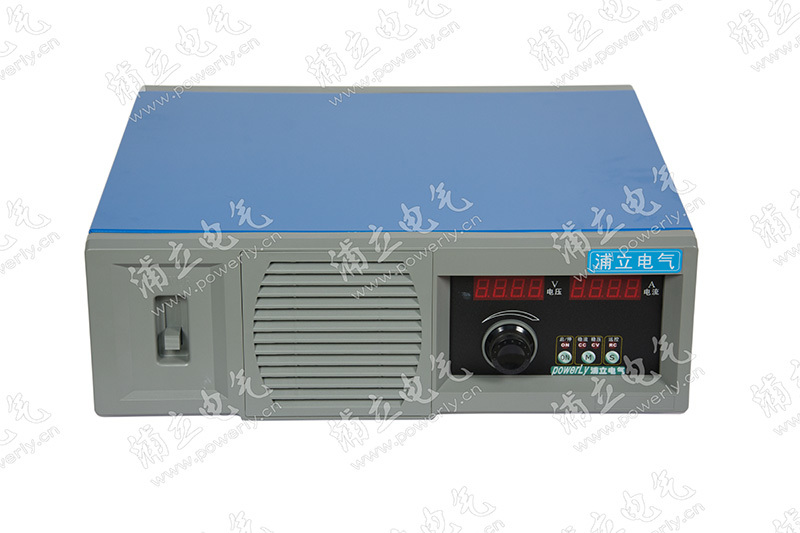
Puli recommends the basic concept of pulse power supply electroplating process:
Pulse power supply electroplating is a new electroplating technology. Its characteristics are determined by the effect of surge current on the dynamics model of the electrode process, the most important of which is the effect on the convective heat transfer process. During DC plating, the metal ions plated out in the plating solution are gradually consumed in the solution around the cathode surface, resulting in a difference in concentration between the plated metal ions at this point and the corresponding positive ions in the solution. This difference increases with the increase of the applied current intensity. When the concentration of the positive ions in the liquid layer around the cathode drops to 0, the limiting current intensity is reached, and the convective heat transfer process is completely controlled by diffusion.

However, during single-pulse electroplating, due to the existence of the relevant off-time, the consumed metal ions use this time to diffuse outward and replenish to the cathode periphery. When the on-off time comes, the concentration of metal ions around the cathode is restored, so a higher current intensity can be used; therefore, the difference between the convective heat transfer process during single-pulse electroplating and the convective heat transfer process during DC plating leads to the fact that the peak current can be much higher than the average current, which promotes the rate of crystal formation far exceeding the rate of crystal growth, making the coating crystals optimized, densely arranged, reduced porosity, and low resistance.
Moreover, the adsorption and desorption processes of various substances on the cathode surface under the continuous cathode polarization potential difference during DC plating are very different from the adsorption and desorption processes under the interrupted high cathode polarization potential difference under single-pulse conditions, resulting in the same solution formula and preservatives. The effects are also very different if the power supply waveform is different.
The pulse power supply has a single-pulse current flow, and can generate a high-density current instantaneously; therefore, during electroplating, the bottom layer should be evenly coated on the workpiece, and it is accelerated to improve efficiency; the surface of the workpiece is uniform and delicate, making gold and silver and other precious metals obtain great savings. Therefore, it can be seen that single-pulse plating power supplies, especially power transformers, that can adjust the slew rate and frequency will be widely used.
The above is the content collected by Guangzhou Puli Electric Co., Ltd. for everyone. If you need customization, please contact us.
MORE INFORMATION

Market and Development Trends of High-Frequency Switching Power Supply Manufacturers
High-frequency switching power supplies are an indispensable core component in modern electronic products. With the rapid development of electronic technology, especially the continuous progress in consumer electronics, communication equipment, and industrial automation, the market demand for efficient, compact, and stable power supplies is increasing. This has led to the booming development of high-frequency switching power supply manufacturers. In this article, we will explore the current market status and development trends of high-frequency switching power supply manufacturers. I. Industry Overview High-frequency switching power supplies are power supply devices that control energy conversion through electronic switching devices (such as transistors). The working principle is to convert the input DC or AC voltage into a stable output voltage through high-frequency switching operations. Compared with traditional linear power supplies, high-frequency switching power supplies have advantages such as small size, high efficiency, and low heat generation, and are widely used in various electronic products such as computers, televisions, communication equipment, and power tools. II. Market Demand With the popularization of smart devices and the requirements of energy saving and environmental protection, the market demand for high-frequency switching power supplies continues to grow. Especially in the fields of consumer electronics, industrial automation, LED lighting, and electric vehicles, modern power supply equipment is increasingly inclined to miniaturization, lightweight, intelligence, and high efficiency. Therefore, high-frequency switching power supply manufacturers
How to judge the technical strength of a high-frequency switching power supply manufacturer?
How to judge the technical strength of high-frequency switching power supply manufacturers? In today's rapidly developing technological era, high-frequency switching power supplies have become core components of numerous electronic devices. They are almost ubiquitous, from household appliances and communication equipment to industrial control systems. So, among the many high-frequency switching power supply manufacturers, how can we judge their technical strength? After all, choosing a manufacturer with strong technology is crucial for product stability and performance improvement. Let's explore this. 1. Understanding the manufacturer's R&D capabilities. First, R&D capability is an important indicator of the technical strength of high-frequency switching power supply manufacturers. We need to see if they have a strong R&D team and multiple independent intellectual property rights. In this field, technology is constantly being updated, and only continuous technological research and development can ensure success in fierce market competition. So, how do we evaluate a manufacturer's R&D capabilities? You can check their number of patents, participation in industry standard setting, and whether they have collaborations with universities or research institutes. If a high-frequency switching power supply manufacturer can continuously launch new technologies and products, their R&D capabilities are undoubtedly trustworthy. 2. Product testing and certification. Secondly, product
The Future of Electrical Equipment Manufacturing: Technological Innovation in High-Frequency Switching Power Supplies In today's rapidly developing era, the electrical equipment manufacturing industry is facing unprecedented challenges and opportunities. In particular, technological innovation in high-frequency switching power supplies is bringing new vitality to this industry. So, what is a high-frequency switching power supply? And how does it drive the future of the electrical equipment manufacturing industry? Basic Concept of High-Frequency Switching Power Supply Simply put, a high-frequency switching power supply is a device that controls energy conversion through high-frequency switching technology. Imagine a faucet; different water pressures and flow rates determine the amount of water supplied. A high-frequency switching power supply is like this faucet, precisely controlling the output of electrical energy. They are widely used in communications, industrial control, medical equipment, and other fields. Technological Innovation in High-Frequency Switching Power Supplies In recent years, the technology of high-frequency switching power supplies has been constantly innovating. First, the improvement in efficiency is obvious. Imagine you are cooking in the kitchen; if the thermal efficiency of the gas stove is improved, you can not only save gas but also shorten the cooking time. This is equally important for high-frequency switching power supplies. By adopting more efficient conversion technologies, manufacturers can not only reduce energy consumption but also reduce the heat generated by the equipment, improving overall performance. Furthermore, the size reduction is also significant.
SUBSCRIPTION INFORMATION
CATEGORY
Contact Us
Address: Room 204, Building 4, CIMC High-tech Intelligent Manufacturing Center, No. 3, Chanxing 1st Road, Xianyong Village, Chencun Town, Shunde District, Foshan City, Guangdong Province
Copyright © 2024 Guangdong Powerly Electric Co., Ltd. All Rights Reserved. Power:www.300.cn SEO License